
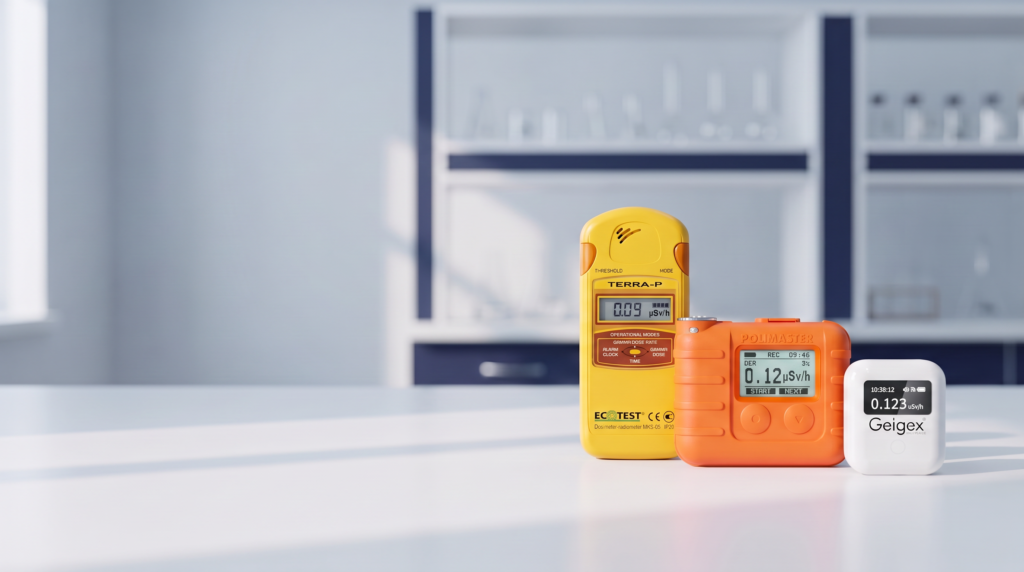
Dosimeter Shop has supplied personal radiation detectors, dosimeters and Geiger counters since 2011. We’re based in Melbourne, Australia, and ship to customers all over the world: individuals and families, travellers, collectors, researchers, schools, emergency services and businesses.
What we sell
We specialise in portable instruments that detect and measure ionising radiation, from simple household detectors to professional dosimeters. We stock four established manufacturers:
- Polimaster: professional personal dosimeters, including gamma, X-ray and gamma-neutron models such as the PM1703-II and PM1610 series.
- Ecotest: the TERRA and TERRA-P dosimeters, popular for everyday checks as well as professional use.
- SOEKS: compact, easy-to-use radiation detectors, plus electromagnetic field (EMF) indicators and nitrate testers.
- Geigex: a credit-card-sized gamma and X-ray dosimeter that fits in a wallet.
Browse all radiation detectors →
Why buy from Dosimeter Shop
- Free worldwide shipping on every order. See delivery information.
- Clear prices in US dollars and secure checkout with PayPal, Visa, Mastercard, American Express, Apple Pay and Google Pay.
- A straightforward returns policy. Read our returns and refunds policy.
- Help choosing the right instrument. Email [email protected] or use our contact form and we’ll point you to the model that suits your needs.
What does a dosimeter do?
A dosimeter is a portable device that measures the accumulated dose of ionising radiation received by a person or an object over a period of time. Most dosimeters measure gamma and X-ray radiation; advanced models used in homeland security and nuclear power plants can also measure beta or neutron radiation. Many of the instruments we sell also show the dose rate, the level of radiation at that moment, and sound an alarm if a threshold you set is exceeded.
Not sure whether you need one? Read our guide: Why use a dosimeter?
The main types of ionising radiation
- Gamma rays and X-rays sit at the high-frequency end of the electromagnetic spectrum, the same spectrum that includes ultraviolet, visible light and radio waves. They are highly penetrating and are effectively stopped only by dense materials such as lead. X-rays are mostly produced by man-made sources such as medical and industrial X-ray equipment.
- Beta particles are negatively charged particles released when an atom decays. They penetrate further than alpha particles but are stopped by a few millimetres of aluminium.
- Alpha particles are heavy, positively charged particles that can be stopped by a sheet of paper or a few centimetres of air. They are mainly a hazard if the source is inhaled or swallowed. Standard Geiger counters struggle to detect alpha directly, but many alpha-emitting materials also give off gamma rays, which can be detected.
- Neutrons are produced mainly in nuclear reactors and by certain radioactive materials, and need specialised detectors such as the Polimaster gamma-neutron models.
Background radiation
Radiation is all around us. Cosmic radiation from space, together with naturally radioactive minerals containing uranium and thorium, produces the background level that any detector will show even when no specific source is nearby. Background levels vary from place to place and with altitude, so it’s worth noting your normal local reading. When you measure a particular object, compare the result with that background level.
Everyday items that can be radioactive
A detector can be an eye-opening tool around the home. Items that may show readings above background include:
- Smoke detectors: many contain a small sealed americium-241 source. Because it’s sealed, you may not see a reading from outside the unit.
- Camping lantern mantles: some older mantles contain thorium. Avoid breathing in the ash.
- Vintage watches and clocks: dials painted with radium to glow in the dark. Newer tritium dials are generally too weak to detect through the glass.
- Old camera lenses: some vintage lenses with a yellow tint contain thorium-doped glass.
- Jewellery and gemstones: some gems are irradiated to change their colour, and some older enamelled (cloisonné) jewellery used uranium-based glazes.
- Rocks and minerals: for example uraninite (pitchblende), carnotite and thorianite.
- Old pottery and glassware: some vintage ceramics, such as early orange Fiesta ware, and “uranium glass” used uranium compounds in the glaze or glass.
Learn more
- Why use a dosimeter?
- Travelling to Japan with a dosimeter
- The Fukushima disaster
- ARPANSA: Understanding radiation (Australian Radiation Protection and Nuclear Safety Agency)
- International Atomic Energy Agency (IAEA)
- US EPA: Radiation protection
Talk to us
Have a question about a detector, an order or shipping to your country? Email [email protected] or send a message through our contact page. We’re happy to help.